
Pediatric Speech Evaluation in Orlando: How Parents Can Avoid Preventable Delays

Updated: Jul 25
Author: Alexandra Paguaga, M.S., SLP
VoxLingua Health | Pediatric Speech Therapy in Orlando & Central Florida
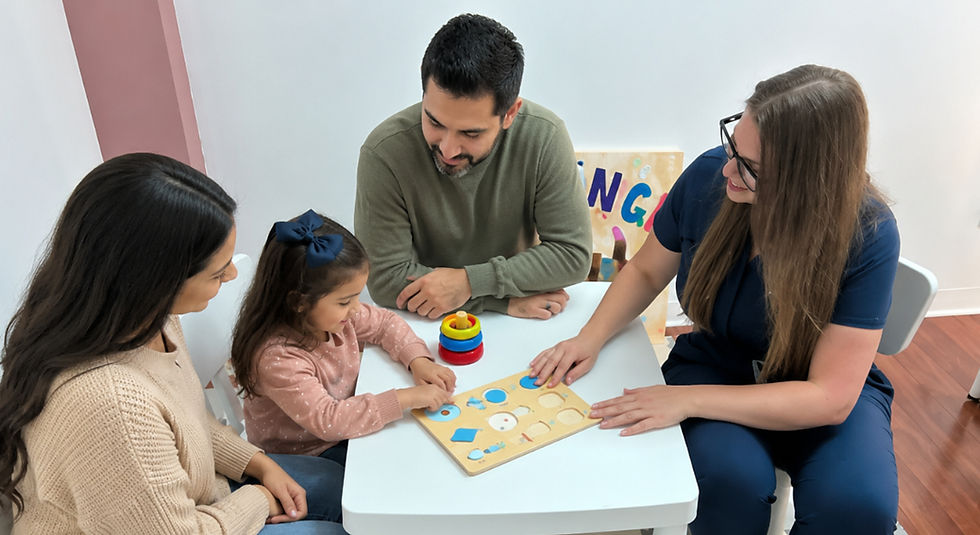
When you are concerned about your child’s speech, language, social communication, or feeding development, waiting for answers can feel stressful.
Families looking for a pediatric speech evaluation in Orlando may have several options, including private speech-language pathology practices, early-intervention programs, school-based evaluations, and referrals through healthcare providers.
Parents can often contact a private pediatric speech-language pathology practice directly. Referral, insurance, and authorization requirements vary, so it is important to confirm them early. Flexible scheduling, prompt paperwork, complete records, and joining a cancellation list may help reduce preventable delays, although no provider can guarantee a specific appointment timeframe.
Quick answer: Contact qualified pediatric speech-language pathology practices directly, clearly describe your child’s primary concern, ask about the earliest evaluation opening, confirm referral and payment requirements, request the cancellation list, and complete intake forms promptly.
An evaluation appointment and an ongoing therapy appointment are not the same. A provider may have an evaluation opening even when preferred weekly therapy times are limited.
What Is a Pediatric Speech-Language Evaluation?
A pediatric speech-language evaluation is an individualized assessment completed by a qualified speech-language pathologist. It examines a child’s communication strengths, identifies areas that may require support, and helps determine appropriate next steps.
Depending on the child’s age and concerns, the evaluation may examine:
Speech clarity and sound production
Motor speech concerns, including suspected childhood apraxia of speech
Expressive language
Understanding of language
Social communication
Fluency
Voice
Early communication
Functional communication
Oral-motor mechanism and functioning
Feeding skills, when appropriate
An evaluation does not automatically mean that a child needs therapy. Recommendations may include therapy, monitoring, parent strategies, hearing testing, school support, another professional referral, or no immediate intervention.
Seven Ways to Reduce Preventable Scheduling Delays
1. Contact a Pediatric Speech-Language Pathology Practice Directly
Parents sometimes assume they must wait for a pediatrician, teacher, school, or daycare to begin the process. In many private-practice settings, a parent can contact the practice directly.
When you call or submit an inquiry, provide:
Your child’s age
Your primary concern
When you first noticed the concern
Whether it involves speech, language, fluency, feeding, or social communication
The languages your child hears and uses
Any previous evaluations or therapy
Your general scheduling availability
Whether you plan to use insurance or private payment
This information helps the practice determine whether the requested evaluation is an appropriate clinical fit.
2. Ask Specifically for an Evaluation Opening
Ask for the earliest available evaluation, not only whether weekly therapy appointments are open.
A useful question is:
“What is your earliest available pediatric speech-language evaluation, and can my child be added to your cancellation list?”
Evaluation appointments and recurring therapy appointments may follow different schedules.
3. Join the Cancellation List
Cancellations happen because of illness, school events, travel, and family schedule changes.
Tell the practice:
Which days you can attend
Whether morning or daytime appointments are possible
How much notice you need
Whether you can accept a same-week opening
Whether you are flexible about appointment times
Broader availability may make it easier to accept an unexpected opening.
4. Confirm Referral and Insurance Requirements Early
Requirements vary by insurance plan, provider, payment method, and service type.
Ask the practice and your insurer:
Is a physician referral or prescription required?
Is prior authorization needed?
Is the provider in network?
Is the evaluation covered separately from therapy?
Are there visit limits?
What portion may be the family’s responsibility?
Are self-pay services available?
Is a superbill available for possible out-of-network reimbursement?
Insurance coverage and clinical recommendations are not always the same. A speech-language pathologist may identify a need even when an insurance plan applies different coverage criteria.
5. Complete Intake Forms Promptly
Incomplete forms can delay scheduling or make it difficult for the clinician to select appropriate assessment materials.
Provide accurate information about:
Pregnancy and birth history
Medical history
Developmental milestones
Hearing history
Communication development
Feeding history, when relevant
Languages used at home
Previous evaluations
School or daycare concerns
Family priorities
Describe what you observe rather than assuming a diagnosis.
For example:
“My child is difficult to understand, says the same word differently at different times, and becomes frustrated when we do not understand.”
This gives the clinician useful information without guessing at the cause.
6. Gather Available Records
Helpful records may include:
Previous speech-language evaluations
Hearing-test results
Early-intervention records
School reports or Individualized Education Programs
Developmental or psychological evaluations
Occupational or physical therapy reports
Teacher or daycare observations
Relevant medical information
Do not delay your initial inquiry simply because every record is not yet available. Ask the practice which documents are most important.
7. Keep More Than One Appropriate Pathway Open
Families may be able to pursue more than one evaluation option.
Evaluation pathway | Who can start the process? | May be appropriate when | Important consideration |
Private pediatric speech-language practice | Parent or caregiver | The family wants an individualized clinical evaluation | Referral, payment, and scheduling requirements vary |
Early-intervention program | Parent, caregiver, or professional | The child is under age 3 and developmental concerns are present | Eligibility is determined through the applicable program |
Public school evaluation | Parent, caregiver, teacher, or school team | The concern affects educational participation | School eligibility criteria differ from private clinical criteria |
Pediatrician or developmental provider | Parent or caregiver through the medical office | Broader medical or developmental concerns are present | Additional referrals may be recommended |
Audiology evaluation | Parent, caregiver, or referring professional | Hearing has not been assessed or hearing concerns are present | A speech evaluation does not replace a hearing evaluation |
A family may pursue a private clinical evaluation while also requesting school or early-intervention support.
What Happens During a Pediatric Speech Evaluation?
The exact process varies, but most evaluations include several components.
Parent or Caregiver Interview
The speech-language pathologist may ask about:
Your concerns
Your child’s developmental history
Communication at home
Languages used by the family
Medical and hearing history
School participation
Social interaction
Family priorities
Previous services
Parent observations are an important part of the assessment.
Child-Friendly Activities
Depending on the child’s age, the evaluation may include:
Play
Looking at pictures
Following directions
Naming objects
Describing scenes
Answering questions
Telling a story
Participating in conversation
Completing structured tasks
A child does not need to “pass” the evaluation. The clinician is looking for patterns, strengths, functional needs, and areas that may require further assessment.
Formal and Informal Assessment
A comprehensive evaluation may include:
Standardized tests
Clinical observation
Language samples
Parent questionnaires
Teacher information
Speech samples
Play-based interaction
Record review
Functional communication tasks
The American Speech-Language-Hearing Association describes speech-language assessment as a process that combines multiple tools and sources of information rather than relying on a single score.
Review of Results
After the evaluation, the clinician may explain:
What was assessed
Your child’s strengths
Areas that may need support
Whether additional information is needed
Whether therapy is recommended
Possible goals
Parent strategies
Hearing, medical, developmental, or school referrals
Recommended follow-up
An evaluation may identify a communication disorder, describe areas of need, or recommend further assessment depending on the findings and setting.
When Should Parents Consider an Evaluation?
Children develop at different rates, and one missed milestone does not automatically indicate a disorder. However, parents do not need to wait until a concern becomes severe.
Consider seeking professional guidance when your child:
Has difficulty understanding language
Uses fewer words or shorter sentences than expected
Is difficult to understand for their age
Becomes frustrated when communicating
Rarely initiates interaction
Has difficulty participating in conversations or play
Shows frequent stuttering with tension or distress
Struggles academically because of language
Is frequently misunderstood by family members, teachers, or peers
Has feeding concerns
Has lost previously acquired communication or feeding skills
Has a communication difference that continues to concern you
The Centers for Disease Control and Prevention encourages families to act on developmental concerns by discussing them with a healthcare provider and asking about appropriate screening or evaluation.
When Hearing Should Be Checked
Hearing should be considered whenever a child has speech or language concerns, even when the child appears to hear everyday sounds.
A speech-language pathologist may recommend an audiology evaluation when:
Hearing has not been tested recently
The child has frequent ear infections
The child responds inconsistently
Speech or language development is delayed
The child frequently asks for repetition
Understanding speech in noise is difficult
A speech-language evaluation does not replace a comprehensive hearing evaluation.
Seek Prompt Medical Guidance for Loss of Skills
Contact your child’s healthcare provider promptly if your child loses words, communication abilities, social engagement, feeding skills, or other previously acquired developmental abilities.
A sudden change accompanied by weakness, facial changes, altered awareness, breathing difficulty, swallowing difficulty, or injury requires immediate medical attention rather than a routine therapy appointment.
Private Evaluation Versus School Evaluation
Private and school-based evaluations serve different purposes.
A private clinical evaluation may examine communication across home, community, and other daily settings. Recommendations are based on the child’s clinical communication profile.
A school evaluation considers whether the communication difficulty affects educational performance and whether the child meets school eligibility criteria. School eligibility is determined by the school team through the applicable educational process.
A child may receive a clinical recommendation for therapy without qualifying for school-based services, or may receive school support based on educational needs. Families may choose to pursue both pathways.
Bilingual English-Spanish Speech Evaluations
Using two languages does not cause a speech or language disorder. A bilingual child’s vocabulary and communication abilities may be distributed across languages. Evaluating only one language can provide an incomplete picture.
A culturally and linguistically responsive evaluation may consider:
Which languages the child hears
Who speaks each language with the child
How often each language is used
The child’s proficiency in each language
Whether concerns appear in one or both languages
Opportunities to learn and use each language
Family and cultural communication patterns
Whether the assessment tools are appropriate
When contacting a practice, ask:
“Does the clinician provide bilingual English-Spanish evaluation, or how will both languages be considered?”
VoxLingua Health provides bilingual English-Spanish services. Families should ask whether the requested bilingual evaluation or treatment service is currently available and appropriate for their child’s needs.
How to Choose a Pediatric Speech-Language Pathologist in Orlando
Availability matters, but clinical fit matters too.
Ask prospective providers:
Is the evaluator a licensed speech-language pathologist?
Does the clinician have experience with children my child’s age?
Does the clinician evaluate my child’s specific concern?
Are bilingual English-Spanish services available?
How are parents involved?
Will results and recommendations be explained clearly?
Is a written report provided?
Are hearing or other referrals recommended when appropriate?
What happens if therapy is recommended?
Is there a cancellation list?
What are the referral and payment requirements?
How can I check current availability?
A pediatric speech-language pathologist is a licensed professional with graduate-level training in evaluating and treating speech, language, communication, and feeding disorders in children.
How to Prepare for the Evaluation
Bring or Submit
Completed intake forms
Insurance information, if applicable
Referral or prescription, if required
Previous evaluations
Hearing-test results
School or daycare records
Current Individualized Education Program, if applicable
A list of medications and relevant diagnoses
Information about every language your child uses
A list of your top concerns
Think About
What does my child do well?
When is communication easiest?
When is communication most difficult?
How does my child communicate needs?
Who understands my child best?
Does my child become frustrated?
Have any skills changed or been lost?
What would meaningful improvement look like for our family?
Prepare Your Child Without Pressure
You might say:
“We are going to meet someone who will play and talk with you so we can learn more about how you communicate.”
Avoid describing the evaluation as a test your child must pass.
Tell the practice about sensory, behavioral, medical, mobility, or accessibility needs before the appointment.
What If Therapy Is Recommended but the Preferred Time Is Not Open?
Ask whether the provider offers:
A therapy waiting list
Morning or daytime appointments
Parent-coaching sessions
Home-practice guidance
Short-term consultation
Referrals to other qualified providers
Coordination with school or early intervention teams
Tele-practice when clinically appropriate, legally permitted, and available
Tele-practice suitability depends on the child’s needs, the service location, provider licensure, and clinical judgment.
An evaluation can still provide useful information even when a preferred recurring therapy time is not immediately available.
What If Therapy Is Not Recommended?
That can also be a helpful outcome.
The speech language pathologist may recommend:
Monitoring development
Parent strategies
A future recheck
Hearing testing
School support
Developmental screening
Another professional evaluation
No immediate intervention
The goal is to help families understand what to watch, how to support development, and when to follow up.
Requesting a Pediatric Speech Evaluation at VoxLingua Health
VoxLingua Health provides pediatric speech-language and feeding therapy services for families in Orlando and Central Florida.
The practice supports children and families with concerns involving:
Speech clarity
Language development
Early communication
Social communication
Fluency
Developmental communication
Bilingual English-Spanish development
Feeding and oral-motor skills when an appropriate feeding evaluation is requested
Families from Orlando, Dr. Phillips, Windermere, Winter Garden, Lake Nona, Winter Park, Kissimmee, and surrounding Central Florida communities may contact the practice to ask about current availability and intake requirements.
Current appointment availability can change, and no specific scheduling timeframe is guaranteed.
A Simple Intake Pathway
Contact VoxLingua Health and describe your child’s age and primary concern.
Share the languages your child uses and any previous evaluation history.
Ask about current availability, referral requirements, and payment options.
Complete the requested intake process and provide relevant records.
Build. Believe. Become.
At VoxLingua Health, evaluation is designed to consider the whole child: communication strengths, daily participation, family priorities, language background, relationships, and emotional experience.
We help families:
Build an understanding of their child’s communication
Believe in their child’s potential
Become informed and confident participants in the next steps
Requesting a Pediatric Speech Evaluation in Orlando from VoxLingua Health
Request information about a pediatric speech-language evaluation in Orlando by contacting VoxLingua Health and sharing your child’s age, primary concern, language background, and scheduling availability.
This article is educational and does not provide a diagnosis or replace individualized medical, developmental, or speech-language advice.
Frequently Asked Questions
Can I contact a pediatric speech-language pathologist directly?
Often, yes. Many private practices accept direct parent inquiries. Referral, insurance, and authorization requirements vary, so confirm them with the practice and your insurer.
What is the difference between an evaluation opening and a therapy opening?
An evaluation is usually a one-time or limited assessment appointment. Therapy requires recurring appointments. A practice may have an evaluation opening even when preferred weekly therapy times are full.
Do I need a pediatrician’s referral?
It depends on the provider, insurance plan, payment method, and service type. Some families can request an evaluation directly, while others may need a referral, prescription, or authorization.
Can I request a private evaluation while waiting for the school?
Yes. Private clinical and school evaluations serve different purposes. Families may pursue both when appropriate.
How long does a pediatric speech evaluation take?
The length varies based on the child’s age, needs, attention, and evaluation type. Ask how much time is reserved and when results will be discussed.
What should I bring?
Bring requested forms, relevant medical and developmental records, hearing results, school reports, previous evaluations, and information about the languages your child uses.
Does an evaluation mean my child will need therapy?
No. Recommendations may include therapy, monitoring, parent education, hearing testing, school support, another referral, or no immediate intervention.
Should bilingual children be evaluated in both languages?
The evaluation should consider all languages the child hears and uses. Skills may be distributed across all languages of exposure.
Can hearing problems affect speech and language development?
Yes. Hearing differences can affect speech clarity, vocabulary, understanding, and communication development. A hearing evaluation may be recommended.
How do I check current evaluation availability in Orlando?
Contact the practice directly, describe the type of evaluation you are seeking, ask for the earliest appropriate opening, and request the cancellation list. Availability can change and is not guaranteed.
About the Author
Alexandra Paguaga, M.S., SLP, is the Founder and Pediatric Speech-Language Pathologist at VoxLingua Health in Orlando, Florida.
She has approximately 20 years of pediatric experience across hospital, outpatient, school, autism diagnostic-team, and private-practice settings. Her clinical experience includes pediatric speech and language development, speech sound disorders, feeding therapy, developmental communication, autism communication support, child development, parent education, and bilingual English-Spanish services.
Alexandra’s approach is child-centered, family-centered, evidence-informed, culturally responsive, and grounded in VoxLingua Health’s philosophy: Build skills, Believe in each child’s potential, and Become a more confident communicator.
Trusted Resources
American Speech-Language-Hearing Association: Assessment Tools and Data Sources
Centers for Disease Control and Prevention: Developmental Milestones
American Speech-Language-Hearing Association: Childhood Hearing Screening
American Speech-Language-Hearing Association: Multilingual Service Delivery
Early Steps

Comments