
Why Does My Child Talk at Home but Not at School? What Parents Should Know

Author: Alexandra Paguaga, M.S., SLP
VoxLingua Health | Pediatric Speech Therapy in Orlando & Central Florida

A child may talk comfortably at home but speak much less, whisper, use gestures, or stay quiet at school for many different reasons. The difference may be related to comfort, classroom demands, temperament, anxiety, multilingual language context, social communication, sensory or regulation needs, or speech clarity. It does not automatically mean a child has selective mutism, autism, a speech-language disorder, or any other diagnosis.
For many parents, this situation feels confusing.
At home, your child may tell stories, ask questions, laugh with siblings, sing songs, or talk throughout the day. Then a teacher says, “We barely hear their voice at school,” or “They do not answer questions in class.”
Both can be true.
Children do not always communicate the same way in every setting. Home is familiar. School, preschool, daycare, and community settings often involve more people, more noise, more transitions, and more pressure to respond quickly.
At VoxLingua Health in Orlando, we help families understand children’s communication patterns across real-life environments so parents can make informed, calm, and confident decisions.
Quick Answer: Why Does My Child Talk at Home but Not at School?
A child who talks at home but not at school may be reacting to differences in comfort, expectations, language demands, social pressure, anxiety, regulation, or confidence. Some children need time to warm up. Some speak easily with family but have difficulty using those same communication skills with teachers, classmates, or unfamiliar adults.

The most helpful first step is not to label the child. The best first step is to observe the pattern.
Look at:
Where your child talks comfortably
Who your child talks to
When your child becomes quiet
Whether your child uses gestures, pointing, whispering, drawing, or writing
Whether the pattern is new, ongoing, or increasing
Whether it affects learning, friendships, safety, confidence, or participation
If the pattern persists or begins to interfere with school participation, a pediatric speech-language evaluation may help clarify what is happening and what support may be appropriate.
What This Pattern Does Not Automatically Mean
A child talking at home but not at school is a communication pattern, not a diagnosis.
It does not automatically mean:
The child is refusing to talk
The child is being defiant
The child has selective mutism
The child has autism
The child has a language disorder
The parents have done something wrong
The teacher has done something wrong
Instead, the pattern tells us that communication may feel easier in some settings and harder in others. That difference deserves careful observation and, when appropriate, professional guidance.
Why School Communication Can Be Harder Than Home Communication
Home communication is often familiar and predictable.
At home, your child may know:
Who is listening
What words are expected
How routines work
That family members understand their speech, gestures, and facial expressions
That they have more time to answer
That mistakes are accepted
School is different.
In a classroom, children may need to:
Answer questions quickly
Speak in front of a group
Follow multi-step directions
Ask for help
Join peer play
Communicate with unfamiliar adults
Use classroom vocabulary
Handle background noise
Shift between activities
Speak while others are watching
A child may easily say, “I want the blue cup,” at home but struggle to say, “Can I have a turn with the blue marker when she is done?” in a busy classroom.
The child has not necessarily “lost” language. The communication situation became more complex.
Common Reasons a Child May Talk at Home but Not at School

There is no single explanation for every child. Several factors may overlap.
1. Comfort and Familiarity
Children often communicate best with people who feel safe, familiar, and predictable.
A child may talk more easily with:
Parents or caregivers
Siblings
Grandparents
One familiar teacher
One trusted friend
Adults who give extra wait time
People who do not pressure them to perform
A child may talk less with:
New teachers
Substitute teachers
Large groups
Unfamiliar peers
Adults who ask rapid questions
People who correct speech frequently
Settings where the child feels watched
This does not mean the child is choosing to be difficult. It may mean the child needs communication to feel safer, more predictable, and less pressured.
2. A Slow-to-Warm-Up Temperament
Some children are naturally cautious in new or busy environments. They may observe before joining, need extra time before answering, or prefer to communicate once they feel settled.
A slow-to-warm-up child may:
Watch other children before participating
Speak softly at first
Avoid being the center of attention
Talk more after several weeks in a classroom
Communicate better one-on-one than in groups
Need predictable routines before using more language
Temperament alone is not a disorder. However, if quietness prevents a child from asking for help, making friends, participating in learning, or expressing basic needs, additional support may be helpful.
The goal is not to change the child’s personality. The goal is to help the child communicate successfully in ways that support comfort, participation, and connection.
3. Anxiety or Pressure to Perform
Some children understand what they want to say but feel unable to speak in certain situations.
School can create communication pressure because children may be asked to answer in front of others, perform, read aloud, greet adults, or respond quickly. Even positive attention can feel overwhelming for some children.
A child experiencing communication-related anxiety may:
Freeze when asked a direct question
Whisper instead of speaking aloud
Avoid eye contact when expected to answer
Nod or point instead of using words
Speak to peers but not adults
Speak outside the classroom but not inside
Talk normally at home but become silent in school settings
This does not automatically mean selective mutism. Anxiety can affect communication in many ways, and the pattern should be understood carefully.
When anxiety seems to be part of the picture, support may involve collaboration between the family, school, pediatrician, speech-language pathologist, and, when appropriate, a qualified mental health professional.
4. Selective Mutism May Be One Possibility, But It Should Not Be Assumed
Selective mutism is one possible reason a child may speak comfortably in some settings, such as home, but have significant difficulty speaking in other settings, such as school. ASHA describes selective mutism as an anxiety-related communication condition and notes that assessment and support are often collaborative across family, school, speech-language, medical, and mental health professionals.
Important: a child who talks at home but not at school does NOT automatically have selective mutism.
Other factors may explain the pattern, including adjustment to a new classroom, temperament, language demands, sensory overwhelm, social communication challenges, bilingual language context, or speech clarity concerns.
Adults should avoid pressuring the child with statements such as:
“Just say it.”
“Why won’t you talk?”
“You talk at home, so talk now.”
“Everyone is waiting.”
Pressure can make communication feel harder. A supportive approach usually works better.
Helpful adult responses may include:
Giving the child extra time
Accepting gestures, pointing, or written responses temporarily
Offering choices instead of open-ended pressure
Building comfort with one trusted adult first
Avoiding public attention around whether the child speaks
Celebrating participation without overreacting
If selective mutism is suspected, families should seek appropriate professional guidance rather than trying to force speech.
5. Multilingual or Bilingual Communication Factors
For bilingual and multilingual children, communication may look different depending on the language, setting, listener, and expectations.
A child may speak confidently in Spanish at home but become quieter in an English-speaking classroom. Another child may understand classroom routines but need more time to respond in the language used at school. Some children may switch languages, use gestures, or rely on familiar words while they are still building comfort and vocabulary.
Learning more than one language does not, by itself, cause or worsen speech or language problems. ASHA explains that using multiple languages with a child does not confuse the child or cause language delays.
Parents can ask:
Which language does my child use most comfortably at home?
Which language is used most at school?
Does my child communicate better with familiar bilingual adults?
Does my child seem quiet because they are still learning the school language?
Are concerns present across languages or mainly in one setting?
For families in Orlando and Central Florida, bilingual English/Spanish speech-language support can be especially helpful when trying to understand whether a child’s quietness is related to language exposure, communication confidence, school demands, or a concern that needs evaluation.
6. Social Communication Differences
Some children can talk well at home but have difficulty using communication socially at school.
Social communication includes knowing how to:
Join play
Start conversations
Take turns
Repair misunderstandings
Ask for help
Read social cues
Use language with different people
Adjust communication for different situations
Understand classroom routines and group expectations
A child may speak in full sentences at home but struggle to enter a peer group, respond to a teacher’s question, or explain a problem during recess.
Parents may hear:
“They play near other children but do not talk much.”
“They answer adults only when prompted.”
“They do not ask for help.”
“They seem unsure how to join the group.”
“They talk about favorite topics but not during classroom activities.”
Social communication differences can occur for many reasons. They may be related to development, anxiety, language needs, attention, autism-related communication differences, or limited experience in group settings.
A professional evaluation can help identify whether the child needs support with social communication, language use, peer interaction, or classroom participation.
7. Sensory, Attention, or Regulation Demands
School environments are often busy.
There may be bright lights, noise, movement, transitions, group directions, playground activity, cafeteria sounds, and multiple people talking at once. For some children, communication becomes harder when their bodies and brains are working hard to stay regulated.
A child may become quieter when they are:
Overstimulated
Tired
Unsure of the routine
Distracted by noise
Sensitive to transitions
Worried about making a mistake
Processing too much language at once
Managing big emotions
Communication is not separate from emotional development. A child who feels overwhelmed may need safety, predictability, connection, and regulation before they can comfortably use words.
Speech-language support may include functional communication, self-advocacy phrases, visual supports, emotional vocabulary, and strategies that help the child communicate needs before frustration builds.
8. Speech Clarity or Confidence Concerns
Some children talk at home because family members understand them, even when their speech is not fully clear. At school, unfamiliar adults and peers may have more difficulty understanding them.
If a child has speech sound or clarity concerns, they may avoid talking because they are tired of repeating themselves or worried others will not understand.
Possible signs include:
Family understands the child better than teachers do
The child becomes frustrated when asked to repeat
Peers misunderstand or ignore the child
The child uses shorter responses at school
The child avoids speaking in groups
The child points instead of saying words in unfamiliar settings
This can affect confidence. A pediatric speech-language evaluation can help determine whether speech sound support may improve intelligibility and participation.
What Parents May See at Home vs. What Teachers May See at School
Parent May See at Home | Teacher May See at School | What It May Suggest |
Talks freely with family | Quiet with teachers | Comfort or familiarity may affect communication |
Tells stories at home | Answers with gestures | Classroom pressure or language demands may feel harder |
Speaks confidently in one language | Quiet in another language setting | Bilingual language context may be part of the picture |
Talks during play | Silent during group time | Social or performance demands may affect participation |
Speaks clearly to family | Avoids talking with peers | Speech clarity or confidence may need support |
Talks after warming up | Quiet at arrival or transitions | Routines, regulation, or adjustment may influence communication |
This type of comparison helps adults move away from “Why won’t my child talk?” and toward “What helps my child communicate?”
Your Child May Be Communicating Without Words
A child who is not talking much at school may still be communicating.
Teachers and parents can observe whether the child uses:
Eye gaze
Pointing
Gestures
Facial expressions
Nodding or shaking head
Showing objects
Drawing
Writing
Leading an adult by the hand
Whispering to one person
Speaking through a peer
Using pictures or visual choices
These forms of communication matter. They give adults clues about what the child understands, wants, avoids, enjoys, and needs.
The goal is usually not to remove nonverbal communication. The goal is to use it as a bridge toward more flexible, confident communication.
What Parents and Teachers Should Observe

Before jumping to conclusions, gather information. A simple observation log can help parents, teachers, and clinicians identify patterns.
What to Observe | Helpful Questions |
People | Does the child talk to parents, siblings, teachers, peers, or only certain people? |
Places | Does the child talk in the classroom, hallway, playground, car, therapy room, or home? |
Activities | Is talking easier during play, snack, reading, art, or one-on-one time? |
Communication type | Does the child use words, whispers, gestures, pointing, drawing, or writing? |
Timing | Is communication easier after warming up, later in the day, or during predictable routines? |
Language | Does the child communicate differently in English, Spanish, or another language? |
Pressure | Does the child shut down when asked direct questions or placed on the spot? |
Participation | Is quietness affecting learning, friendships, safety, or independence? |
This information can be very useful during a speech-language evaluation.
Questions Parents Can Ask the Teacher
A calm, collaborative conversation with the teacher can reveal patterns parents may not see at home.
Try asking:
“When do you hear my child talk the most?”
“Who does my child communicate with most comfortably?”
“Does my child use gestures, pointing, writing, or whispering?”
“Does my child answer yes/no questions or make choices?”
“Is my child quiet all day or only during certain activities?”
“Does my child seem anxious, unsure, distracted, or overwhelmed?”
“How does my child ask for help?”
“Does this affect classroom participation or peer interaction?”
“Are there times my child communicates more outside the classroom?”
“What strategies seem to help?”
These questions help parents and teachers work as a team.
What Parents Can Do This Week
You do not have to solve the entire concern immediately. Start with small, supportive steps.
1. Stay calm and curious
Try saying, “Your teacher shared that talking at school feels hard sometimes. We can figure it out together.”
2. Avoid forcing speech
Instead of “Say hi,” try, “You can wave, smile, or say hi when you are ready.”
3. Practice useful school phrases
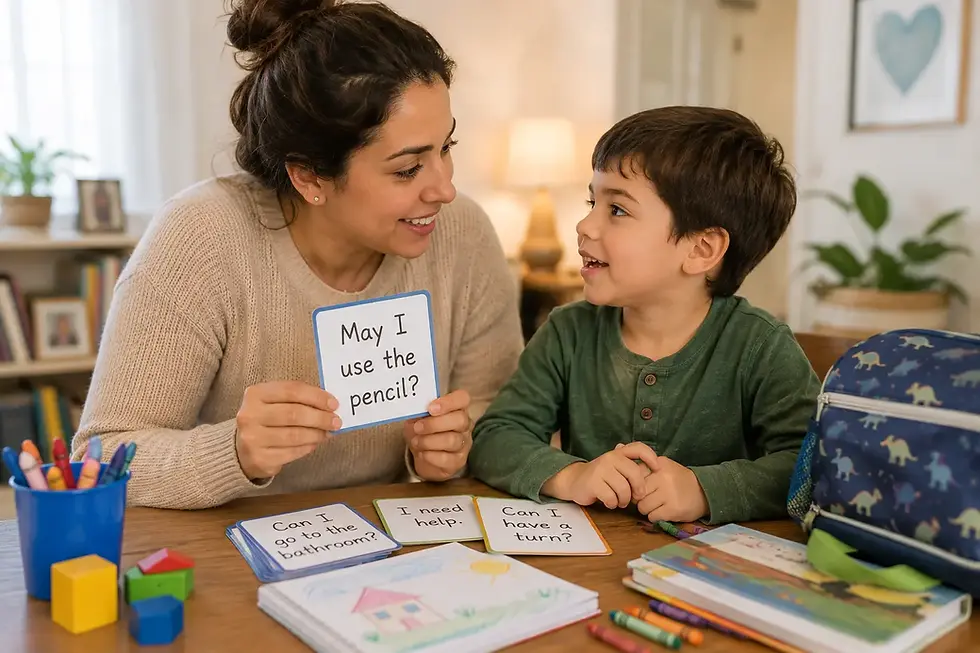
Practice simple phrases during relaxed play:
“Can I have help?”
“I need a break.”
“Can I play?”
“My turn?”
“I do not know.”
“Can you say it again?”
4. Offer choices
Instead of asking, “What did you do at school?” try:
“Did you play outside or stay inside?”
“Did you sit near your teacher or near a friend?”
“Was music loud or quiet today?”
Choices reduce language pressure while still encouraging communication.
5. Share helpful strategies with the school
Let the teacher know what helps your child communicate at home. Examples may include extra wait time, visual choices, warm-up time, or one-on-one connection before group participation.
What Teachers Can Try at School
Teachers can support communication without putting the child on the spot.
Helpful strategies may include:
Giving wait time after asking a question
Avoiding public pressure to speak
Allowing pointing, gestures, writing, or choices
Pairing the child with a trusted peer
Starting with yes/no or choice questions
Encouraging participation without spotlighting speech
Creating predictable routines
Offering visual supports
Privately sharing observations with parents
A child may need gradual steps. For example, the child may first point, then whisper to a teacher, then answer quietly one-on-one, then speak in a small group.
Progress should be measured by increasing comfort, participation, and communication confidence, not by forcing speech before the child is ready.
Is This Temporary, or Should Parents Seek Support?
Some children need time to adjust to a new classroom. Others need additional support.
It May Be Temporary When… | Professional Guidance May Help When… |
The child is new to the school or classroom | The pattern continues beyond the adjustment period |
The child gradually becomes more comfortable | Communication does not improve or becomes more limited |
Quietness happens only at arrival or during new routines | The child cannot ask for help or express basic needs |
The child communicates with at least one teacher or peer | The child avoids most school communication |
The child participates in other ways | Quietness affects learning, safety, friendships, or confidence |
Parents and teachers see steady progress | Parents and teachers share ongoing concern |
When in doubt, it is appropriate to ask questions early. A professional evaluation can provide clarity without assuming a diagnosis.
When Should Parents Seek Professional Support?
Parents may want to seek guidance if limited communication at school:
Lasts more than a brief adjustment period
Interferes with learning or participation
Prevents the child from asking for help
Affects friendships or play
Causes visible distress
Happens across multiple school or community settings
Is paired with unclear speech, difficulty following directions, or limited language use
Is more noticeable than expected for the child’s age
Concerns both parents and teachers
Causes the child to avoid school or group activities
The CDC describes developmental monitoring as watching how a child grows and changes over time in how they play, learn, speak, act, and move. Developmental screening uses formal tools to help identify concerns, including language, behavior, movement, thinking, and emotions. The American Academy of Pediatrics also supports ongoing developmental surveillance and screening, with referral for further evaluation when concerns are identified.
A speech-language evaluation does not mean something is “wrong” with your child. It is a way to understand your child’s strengths, needs, communication patterns, and next steps.
How a Pediatric Speech-Language Evaluation Can Help
A pediatric speech-language evaluation can help answer questions such as:
Does my child understand classroom routines and language expectations?
Can my child express wants, needs, ideas, and feelings clearly?
Is speech clarity affecting confidence?
Does my child communicate differently with adults and peers?
Are bilingual language factors part of the picture?
Does my child need support with social communication?
Are anxiety, regulation, or environmental demands affecting communication?
Would parent coaching or school collaboration be helpful?
A speech-language evaluation looks at patterns across settings, not just whether a child can talk in one familiar environment.
For families in Orlando, Winter Garden, Windermere, Lake Nona, Dr. Phillips, Winter Park, Kissimmee, and surrounding Central Florida communities, local pediatric speech-language support can help connect home and school observations.
What Support May Look Like
Support depends on the child’s needs. It may include:
Parent education
Teacher collaboration
Pediatric speech-language therapy
Social communication support
Bilingual English/Spanish communication support
Functional school communication goals
Visual supports
Confidence-building routines
Coordination with pediatricians or other providers
Referral to mental health support if anxiety appears significant
Support should be individualized. A child who is shy and warming up to preschool may need a different plan than a child who cannot ask for help, avoids most school communication, or becomes distressed when expected to speak.
Pediatric Speech Therapy in Orlando: When VoxLingua Health Can Help
If your child talks comfortably at home but becomes very quiet at school, daycare, preschool, or community activities, VoxLingua Health can help you explore what may be happening.
Families may benefit from support when they want to understand:
Whether communication differences are related to school demands
Whether speech clarity, language, or social communication is affecting participation
Whether bilingual communication patterns are being misunderstood
Whether the child needs help asking for help, joining play, or speaking with unfamiliar adults
Whether a pediatric speech-language evaluation is appropriate
VoxLingua Health serves children and families in Orlando and Central Florida with pediatric speech-language evaluations, pediatric speech therapy, bilingual English/Spanish services, feeding therapy, parent education, and developmental communication support.
The goal is not to pressure your child into talking. The goal is to help your child build skills, believe in their communication, and become more confident across the places that matter most.
What Not to Do
When parents are worried, it is natural to want quick answers. But some responses can accidentally make communication harder.
Try to avoid:
Publicly demanding that the child talk
Comparing the child to siblings or classmates
Saying, “You talk at home, so why won’t you talk here?”
Treating silence as defiance without understanding the pattern
Punishing the child for not speaking
Forcing greetings or performances
Ignoring teacher concerns because the child talks at home
Assuming one diagnosis based on one behavior
Instead, focus on observation, support, collaboration, and professional guidance when needed.
Key Takeaways for Parents
A child may talk at home but not at school for many reasons.
This pattern does not automatically mean selective mutism or any other diagnosis.
School communication is often harder because it involves more people, expectations, noise, transitions, and social demands.
Bilingual children may communicate differently depending on language exposure, comfort, and setting.
Parents and teachers should observe patterns across people, places, activities, languages, and communication types.
Professional support may be appropriate when limited school communication affects learning, safety, friendships, confidence, or participation.
A pediatric speech-language evaluation can help clarify the child’s strengths, needs, and next steps.
Frequently Asked Questions
1. Why does my child talk at home but not at school?
Your child may feel more comfortable at home because the people, routines, language, and expectations are familiar. School can involve more noise, social pressure, group participation, unfamiliar adults, and communication demands. The pattern should be observed carefully rather than immediately labeled.
2. Does this mean my child has selective mutism?
No. Selective mutism is one possible consideration, but a child who talks at home and not at school does not automatically have selective mutism. Other factors, such as temperament, anxiety, language demands, bilingual development, speech clarity, sensory overwhelm, or social communication needs, may also contribute.
3. Is my child just shy?
Possibly, but shyness does not explain every situation. Some children are naturally slow to warm up. However, if your child’s quietness prevents them from asking for help, participating in class, making friends, or expressing needs, it may be helpful to seek professional guidance.
4. Should I force my child to talk at school?
No. Forcing speech can increase pressure and make communication harder for some children. It is usually more helpful to reduce pressure, offer choices, give wait time, accept nonverbal communication, and build confidence gradually.
5. What should I ask my child’s teacher?
Ask when your child communicates most, who they communicate with, whether they use gestures or whispering, whether quietness affects participation, and what strategies help. Teacher observations can reveal patterns that parents may not see at home.
6. Can bilingual children be quieter at school?
Yes. A bilingual child may be more comfortable in one language or may need more time to respond in the school language. Bilingualism itself does not cause speech or language problems, but a bilingual speech-language evaluation can help determine whether concerns are related to language exposure, communication development, or another factor.
7. Can anxiety affect talking at school?
Yes. Some children become quieter, whisper, freeze, or avoid speaking when they feel anxious or pressured. Anxiety should be considered carefully and may require collaboration among parents, teachers, pediatricians, speech-language pathologists, and mental health professionals when appropriate.
8. When should I be concerned?
Consider support if your child’s limited communication at school persists, causes distress, affects learning or friendships, prevents them from asking for help, or occurs across multiple settings. Concerns shared by both parents and teachers are especially important to explore.
9. Can a speech-language pathologist help if my child talks at home?
Yes. Speech-language pathologists evaluate how children communicate across different people, places, tasks, and demands. A child may have strong home communication but still need support using speech, language, or social communication skills in school settings.
10. What if my child uses gestures but not words at school?
Gestures are meaningful communication. Pointing, nodding, showing, drawing, or writing can help adults understand your child’s needs and can be used as stepping stones toward more flexible communication.
11. Should I talk to my pediatrician?
Yes, especially if you have concerns about development, anxiety, school participation, language, hearing, behavior, or regression. Your pediatrician can help determine whether developmental screening, hearing testing, speech-language evaluation, or another referral may be appropriate.
12. Where can I find pediatric speech therapy in Orlando for school communication concerns?
VoxLingua Health provides pediatric speech-language evaluations and therapy for children in Orlando and Central Florida. If your child talks at home but struggles to communicate at school, an evaluation can help clarify what may be contributing to the pattern and what support may help.
Conclusion
When a child talks at home but not at school, parents deserve more than a quick label. The difference may be related to comfort, communication demands, anxiety, temperament, bilingual language context, social communication, speech clarity, regulation, or a combination of factors.
The most helpful approach is calm observation, supportive collaboration with the school, and professional guidance when the pattern affects the child’s participation or confidence.
At VoxLingua Health, we help families build understanding, believe in each child’s potential, and support children as they become more confident communicators at home, school, and beyond.
If you are concerned about your child’s communication at school, consider scheduling a pediatric speech-language evaluation with VoxLingua Health in Orlando.
Author Bio
Alexandra Paguaga, M.S., SLP is the Founder of VoxLingua Health and a pediatric speech-language pathologist serving children and families in Orlando and Central Florida. She has more than 20 years of pediatric clinical experience across hospital, outpatient, school, and private practice settings.
Alexandra supports children with speech, language, communication, feeding, developmental, and social communication needs. Her background includes participation on autism diagnostic teams in hospital settings and providing bilingual English/Spanish services. Through VoxLingua Health, Alexandra helps families build skills, believe in each child’s potential, and become more confident communicators through evidence-informed, family-centered care.
Disclaimer
This article is for educational purposes only and is not intended to diagnose, treat, or replace individualized medical, developmental, psychological, or speech-language guidance. A child who talks at home but not at school may be experiencing communication differences for many possible reasons, and this pattern does not automatically indicate selective mutism, autism, a speech-language disorder, anxiety, or any other diagnosis.
If you have concerns about your child’s speech, language, communication, learning, behavior, anxiety, hearing, feeding, or development, speak with your child’s pediatrician and consider a professional evaluation. A pediatric speech-language evaluation can help clarify your child’s communication strengths, needs, and next steps.
External References
This article was informed by trusted pediatric communication and developmental guidance from the following organizations:
American Speech-Language-Hearing Association. “Selective Mutism.”https://www.asha.org/practice-portal/clinical-topics/selective-mutism/
American Speech-Language-Hearing Association. “Learning More Than One Language.”https://www.asha.org/public/speech/development/learning-more-than-one-language/
Centers for Disease Control and Prevention. “Developmental Monitoring and Screening.”https://www.cdc.gov/act-early/about/developmental-monitoring-and-screening.html
American Academy of Pediatrics. “Promoting Optimal Development: Identifying Infants and Young Children With Developmental Disorders Through Developmental Surveillance and Screening.”https://publications.aap.org/pediatrics/article/145/1/e20193449/36971/Promoting-Optimal-Development-Identifying-Infants
Related Articles
Pediatric Speech Evaluation in Orlando - https://www.voxlinguahealth.com/post/pediatric-speech-evaluation-orlando
Speech Sound Disorders in Children - https://www.voxlinguahealth.com/post/speech-sound-disorders-children-orlando
Speech Delay vs. Autism - https://www.voxlinguahealth.com/post/speech-delay-vs-autism

Comments